Why Taroudannt?
Nestled in the fertile Souss Valley at the foot of the High Atlas and Anti-Atlas mountains, Taroudannt is one of Morocco's oldest and best-preserved medinas. Often called "little Marrakech," it is everything Marrakech was before the tourist economy arrived — unhurried, genuine, wildly beautiful. The city sits roughly 80 km east of Agadir, making it an accessible base for exploring southern Morocco without the coastal crowds.
The city walls alone — 7.5 km of perfectly intact 16th-century ramparts — are a destination in their own right. Add a working medina, a daily Berber market, five-star riad hotels at three-star prices, and access to some of Morocco's most dramatic desert-edge landscapes, and Taroudannt becomes one of the most rewarding travel decisions you can make.
1. Cycle or Walk the Ramparts
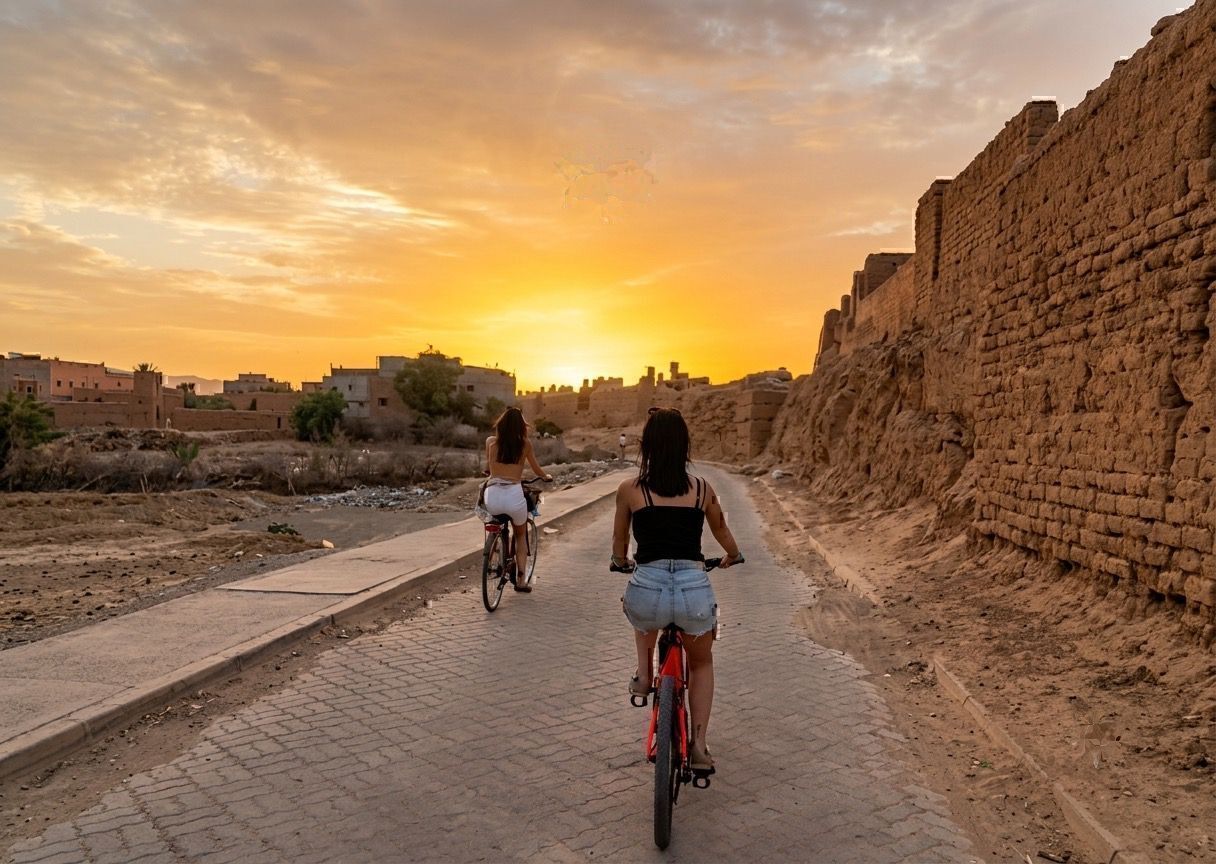
The iconic rose-red walls of Taroudannt stretch for 7.5 kilometres and are among the best-preserved city ramparts in Africa. Rent a bicycle from Place Assarag for around €3 an hour and circle the entire city as the sun sets and the walls shift from terracotta to deep amber. The circuit takes about 45 minutes on a bike, or 2 hours on foot. Either way, the views of the palmeries, the mountains beyond and the slow Moroccan pace of life outside the walls are extraordinary.
If you'd rather experience the ramparts properly, our guided bike tour takes you along the walls at the golden hour with a local expert who can point out the towers, gates and history along the way.
The best light for the ramparts is 45 minutes before sunset. Position yourself at the south-western stretch near Bab Oulad Bounouna for the classic photograph with the Atlas mountains as a backdrop.
2. Get Lost in the Souk
Taroudannt's medina is compact enough to explore without a guide but rich enough that you'll still be discovering new lanes after three days. The main market area centres on Place Assarag and Place Talmoktar, from where a web of covered lanes leads to specialist zones: the spice souk, the jewellery section, the pottery quarter, the argan oil vendors, the leather tanneries and the woodworking workshops.
Unlike Marrakech's souks, haggling here is friendly rather than aggressive. Sellers are proud of their craft and genuinely happy to show you how things are made. Come in the morning for the freshest produce market, return at noon for lunch in one of the no-sign restaurants the locals use, and browse the boutiques in the cool of the late afternoon.
3. Day Trip to Tiout Oasis
Just 37 km from Taroudannt along a scenic road through the Souss plain, the Tiout palm grove is one of the most photogenic corners of southern Morocco. Several thousand date palms crowd around a series of natural springs, with a crumbling kasbah perched above and the High Atlas rising in the background.
The oasis is famously the location where Orson Welles filmed parts of Othello in 1952. Wander the palmerie, take tea in the small café by the springs, and climb to the kasbah ruins for a view over the palms that hasn't changed much since Welles was here. A half-day trip leaves plenty of time to be back in Taroudannt for dinner. Read our full Tiout guide →
4. Ride a Horse Through the Foothills
The landscape around Taroudannt — gently rolling plains of orange earth, argan forests and distant snow-capped peaks — is tailor-made for horseback exploration. Our horseback excursion follows ancient Berber caravan trails through villages and almond groves, covering terrain no vehicle could reach.
Horses are calm, well-cared for and suitable for riders of all levels. The golden light of early morning or late afternoon turns the Anti-Atlas foothills into something almost hallucinatory. This is Morocco as it looked five hundred years ago. Read our horseback riding guide →
5. Quad Bike Through the Palm Groves
For a more adrenaline-fuelled way to see the Souss plain, a quad bike excursion through the palmeries and open tracks around Taroudannt is hard to beat. Routes run through date palm groves, along dry riverbeds, past Berber villages and into the scrubland where the plain meets the first Anti-Atlas ridges.
No previous experience is needed — routes are available for beginners through to experienced riders, and safety briefings are thorough. Read our quad biking guide →
6. Learn Traditional Leather Craft
Taroudannt has been a leather-working city since the medieval period, and its craftsmen still use techniques passed down through generations. A workshop session with one of the old city's master tanners and leatherworkers gives you a hands-on understanding of how hides are treated, dyed and worked into the bags, belts and babouche slippers you see throughout the souks.
You'll leave with a piece you made yourself — a small wallet or bracelet — and a completely different appreciation for every leather item you see for sale. Book the leather workshop through our activities page.
7. Visit the Tiskiwin Museum
Tucked into a quiet corner of the medina, the Tiskiwin Museum houses a remarkable private collection of Saharan and sub-Saharan artefacts assembled by Dutch anthropologist Bert Flint over sixty years of fieldwork. Jewellery, textiles, saddles, musical instruments and ceremonial objects trace the trans-Saharan caravan routes that once made Taroudannt one of southern Morocco's wealthiest trading cities. Entry costs a few dirhams and the place is almost always empty — it's one of the most peaceful hours you'll spend in any Moroccan city.
8. Breakfast at Place Assarag
Taroudannt's main square is the city's living room. Pull up a plastic chair at one of the terrace cafés before 9am when the square belongs entirely to locals: schoolchildren on their way to class, traders setting up stalls, elderly men nursing glasses of mint tea, mopeds weaving through the chaos. Order msemen (flaky griddle bread) with honey and argan oil, a glass of fresh orange juice and a café au lait. Total cost: around €2. Quality: impossible to beat.
Fresh orange juice is one of Morocco's great pleasures and Taroudannt is in the heart of the orange-growing region. A glass costs 5–7 MAD (about €0.50). Always ask for it sans sucre — without sugar — or you'll get a different drink entirely.
9. Take the Tizi n'Test Mountain Road
The Tizi n'Test pass (2,092m) is one of the most dramatic mountain roads in Morocco, connecting the Souss Valley to Marrakech through the spine of the High Atlas. The route, carved out of sheer rock faces in the 1920s, winds through Berber villages, cedar forests and jaw-dropping gorges. It is not a road for nervous drivers, but if you have any interest in Moroccan mountain landscapes, it is absolutely unmissable. Allow a full day, start early and stop at the 12th-century Tin Mal mosque on the way — one of the oldest and most important mosques in Morocco, open to non-Muslims.
10. Eat Tangia and Mechoui
Taroudannt's food culture is proudly Soussi — different from Marrakchi cooking and far less known to tourists. Look for mechoui (slow-roasted lamb sold by weight from whole carcasses) in the small square near the main mosque from late morning onwards. For something more unusual, try tangia — a meat and spice mixture slow-cooked overnight in a clay urn buried in the embers of the hammam furnaces. It's ordered the day before and collected in the morning, and it is extraordinary. Ask at your riad for the best place to find it.
Getting to Taroudannt
Taroudannt is 80 km east of Agadir Airport, a 75-minute drive on good roads. CTM buses run several times daily from Agadir. If you're coming from Marrakech, the Tizi n'Test route is spectacular (3.5–4 hours); the faster option via Agadir takes about 3.5 hours on the motorway.
When to Visit
The ideal months are October through April, when daytime temperatures are a comfortable 18–26°C. Summer (June–August) is very hot in the Souss Valley — often 38°C or above — though the dry heat is easier to manage than coastal humidity. Spring brings almond and orange blossom to the surrounding countryside.